
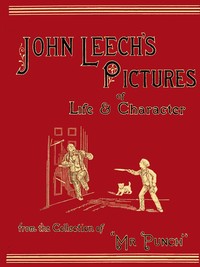
John Leech's Pictures of Life and Character, Vol. 1 (of 3) by John Leech
Let's clear something up right away: this isn't a storybook in the traditional sense. John Leech's Pictures of Life and Character is a curated album of his best social cartoons, originally published in the famous Punch magazine between the 1840s and 1850s. There's no linear plot. Instead, each page presents a snapshot—a single-panel comic of its day—capturing the absurdities, annoyances, and small triumphs of Victorian middle-class life.
The Story
Think of it as a visual diary of an era. One cartoon shows a family's disastrous attempt at a seaside holiday, complete with grumpy children and blowing sand. Another pokes fun at the awkwardness of early railway travel or the perils of wearing an impossibly wide crinoline skirt through a doorway. There are hunting mishaps, struggles with newfangled inventions, and the universal pain of dealing with tedious relatives. Leech doesn't target politicians or royalty here; his subjects are the ordinary, slightly flustered people trying to navigate the new rules of their rapidly changing world. The 'story' is the collective, comedic portrait of a society seeing itself in a mirror for the first time.
Why You Should Read It
I loved this book because it completely dismantles the stiff, formal image we often have of the Victorians. These cartoons are full of warmth and recognition. The father pretending to understand his son's homework, the couple silently arguing at the dinner table, the sheer chaos of a crowded street—it's all deeply familiar. Leech had a genius for observation, and his art style isn't harsh or cruel; it's affectionate teasing. Reading it, you get a sense of the daily textures of life—the fashions, the furniture, the social anxieties—in a way that history books rarely convey. It's a masterclass in finding humor in the mundane.
Final Verdict
This is a perfect book for anyone curious about social history but bored by dry facts. It's for fans of cartoons, from The New Yorker to modern webcomics, who want to see the roots of the form. It's also a great pick for readers who enjoy 'slice of life' stories and character studies. You can read it cover-to-cover or just flip it open to any page for an instant smile. Just be warned: you'll start spotting 'Leech moments' in your own modern life. A delightful, humanizing window into the past that proves people have always been a little ridiculous, in the best way.
This digital edition is based on a public domain text. Thank you for supporting open literature.
Robert Anderson
9 months agoI stumbled upon this title during my weekend research and the quality of the diagrams and illustrations (if applicable) is top-notch. It’s hard to find this much value in a single source these days.
Linda Jones
1 month agoI've been looking for a reliable source on this topic, and the insights into future trends are particularly thought-provoking. This adds significant depth to my understanding of the field.
Richard Martinez
1 year agoComparing this to other titles in the same genre, the author doesn't just scratch the surface but goes into meaningful detail. Definitely a five-star contribution to the field.
Elizabeth Williams
1 year agoThe methodology used in this work is academically sound.





Paul Brown
3 months agoThe clarity of the introduction set high expectations, and the level of detail in the second half of the book is truly impressive. This is a solid reference for both beginners and experts.