
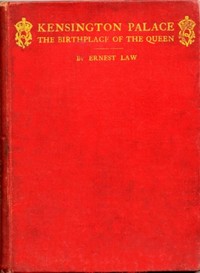
Kensington Palace, the birthplace of the Queen by Ernest Law
Most of us know Kensington Palace as a tourist stop or the home of modern royals. Ernest Law’s book asks us to forget all that and start from the beginning. It’s a biography of a building, from its humble start as Nottingham House to its transformation into a royal residence that shaped British history.
The Story
The plot is the palace itself. Law walks us through its physical and political evolution. We see William and Mary buying the place because William’s asthma couldn’t handle the damp air of Whitehall. We witness the frantic expansion, the addition of the famous gardens, and the creation of the King’s and Queen’s staircases. The narrative is driven by the people who lived and died within its walls: Queen Anne overseeing the creation of the Orangery, young Princess Victoria being woken to learn she was queen, and the sorrow that seemed to cling to the rooms after Prince Albert’s death. It’s less a dry list of facts and more a series of connected episodes showing how each resident left their mark, for better or worse.
Why You Should Read It
What makes this book special is its focus on the everyday life within grand history. Law digs into the practicalities—how the rooms were heated, what the kitchens were like, how disease ripped through the royal nurseries. You get a sense of the palace as a living, breathing, and often inconvenient home. He doesn’t shy away from the darker moments, like the intense isolation of Victoria’s childhood or the political machinations that used the palace’s private rooms as a stage. It makes the past feel immediate and human. You stop seeing a museum and start seeing a family home with incredibly high-stakes drama.
Final Verdict
This is a perfect pick for anyone who loves ‘behind-the-scenes’ history. If you enjoy stories about how places shape people (and vice versa), you’ll be hooked. It’s ideal for royal history fans who want to go deeper than the typical biographies, and for London enthusiasts curious about the city’s layers. While it’s an older book, Law’s clear, scene-by-scene storytelling makes it an easy and engaging read. Just be warned: you’ll never look at that red-brick facade the same way again.
This work has been identified as being free of known copyright restrictions. Distribute this work to help spread literacy.
Sarah Taylor
1 year agoI found the author's tone to be very professional yet accessible, the argument presented in the middle section is particularly compelling. The insights gained here are worth every minute of reading.
Elizabeth Moore
1 year agoIt took me a while to process the complex ideas here, but the author manages to bridge the gap between theory and practice effectively. Simple, effective, and authoritative – what else could you ask for?
Linda Perez
5 months agoI decided to give this a try based on a colleague's recommendation, the quality of the diagrams and illustrations (if applicable) is top-notch. Simple, effective, and authoritative – what else could you ask for?
Mary Garcia
7 months agoI particularly value the technical accuracy maintained throughout.







Barbara Thompson
3 months agoFrom a researcher's perspective, the formatting on mobile devices is surprisingly crisp and clear. It cleared up a lot of the confusion I had previously.