
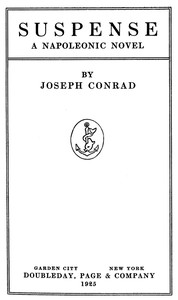
Suspense: A Napoleonic Novel by Joseph Conrad
Joseph Conrad is famous for his tales of the sea and the human heart under pressure, but in Suspense, he turns his sharp eye to dry land and the political powder keg of post-Napoleonic Europe. It’s his final, unfinished novel, and it captures a world frozen in a moment of dangerous anticipation.
The Story
The story centers on Cosmo Latham, a well-meaning but somewhat naive Englishman visiting Genoa in 1815. The news of Napoleon’s escape from Elba and his defeat at Waterloo has just broken, but the consequences are still rippling out. Genoa is a hotbed of intrigue, filled with royalist spies, Bonapartist loyalists, and ordinary people just trying to survive the shifting tides. Cosmo becomes fascinated by the local gossip about a secret, high-status prisoner held in the nearby fortress of Porto Ferraio. His curiosity pulls him into a web of clandestine meetings and cryptic warnings, especially through his interactions with the clever and enigmatic Countess Helion de Montevesso. The plot isn’t about chases or sword fights; it’s about the heavy, quiet weight of not knowing what comes next.
Why You Should Read It
Forget the sweeping battle narratives. This book is about the psychological landscape of a crisis. Conrad is brilliant at showing how political upheaval filters down to the personal level. The ‘suspense’ of the title isn’t just about a prisoner’s identity; it’s the suspended animation of a society waiting for its fate to be decided. You feel the paranoia and the oppressive heat of rumor. Cosmo is a great lens for this—he’s an outsider, so we discover the layers of deception alongside him. The characters, especially the countess, are beautifully sketched, full of hidden motives and unspoken histories. You read it for the atmosphere, the exquisite tension in a simple conversation, and the feeling that history is being made just off the page.
Final Verdict
This is a book for a specific, wonderful kind of reader. It’s perfect for history buffs who prefer intrigue over infantry, and for fans of literary fiction who enjoy a slow, character-driven burn. If you love the tense, talky scenes in a good spy novel or the dense atmosphere of classic film noir, you’ll find a lot to love here. Just know going in that it’s unfinished—Conrad’s manuscript ends mid-scene. But honestly, that almost adds to the effect. You’re left in that same state of suspense as the characters, forever waiting for the other shoe to drop, which is a strangely powerful and fitting way to experience this unique slice of Conrad’s genius.
This book is widely considered to be in the public domain. It serves as a testament to our shared literary heritage.
Karen Davis
10 months agoHaving read the author's previous works, it manages to maintain a consistent flow even when discussing difficult topics. If you want to master this topic, start right here.
Edward Walker
1 year agoPerfect.
Richard Young
1 year agoFrom the very first page, the storytelling feels authentic and emotionally grounded. I learned so much from this.
Dorothy Gonzalez
4 months agoRecommended.

Christopher Lee
6 months agoGiven the current trends in this field, the quality of the diagrams and illustrations (if applicable) is top-notch. Top-tier content that deserves more recognition.