
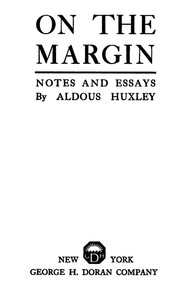
On the Margin: Notes and Essays by Aldous Huxley
Let’s clear something up first: this isn't a novel. There’s no protagonist, no villain, and no plot twist. 'On the Margin' is a collection of essays and short pieces Huxley wrote for magazines in the early 1920s. Think of it as a series of brilliant, slightly scattered observations. He jumps from topic to topic—art, literature, travel, society—like a curious bee in a garden of ideas. One minute he’s analyzing a painting, the next he’s poking fun at the plots of cheap romances, and then he’s wondering aloud about the future of humanity. The ‘story’ is simply the journey of a fiercely intelligent man trying to make sense of a world that had just been shattered by war and was now rebuilding itself in strange, new ways.
Why You Should Read It
You should read this because Huxley is hilariously perceptive. His wit is a scalpel, and he uses it to dissect the fads and follies of his time, many of which feel weirdly familiar today. He writes about the emptiness of sensationalist media and the shallow pursuit of novelty, and you’ll find yourself nodding along. But it’s not all criticism. There’s a real sense of wonder here, too—a genuine fascination with how people think and create. Reading these essays, you get the raw material that would later shape his famous novels. You see him testing ideas, playing with perspectives, and sharpening the voice that would define his career. It’s like watching a master painter’s preliminary sketches.
Final Verdict
This book is perfect for curious thinkers and fans of great non-fiction writing. If you enjoy writers like George Orwell or Joan Didion, who blend personal insight with cultural commentary, you’ll feel right at home. It’s also a great pick for anyone who loved 'Brave New World' and wants to understand the man behind the dystopia. Fair warning: it’s not a light, breezy read. It demands a bit of your attention. But if you’re willing to slow down and engage with it, 'On the Margin' offers a stunningly clear and witty snapshot of a pivotal moment in history, seen through the eyes of one of its sharpest observers. It’s a reminder that the best essays don’t give you answers—they teach you how to ask better questions.
The copyright for this book has expired, making it public property. Share knowledge freely with the world.
Nancy Anderson
10 months agoFrom the very first page, it provides a comprehensive overview perfect for everyone. I would gladly recommend this title.
Mason Wright
4 months agoThe fonts used are very comfortable for long reading sessions.
Steven Miller
4 months agoFinally a version with clear text and no errors.
Jennifer Davis
9 months agoI started reading this with a critical mind, the insights into future trends are particularly thought-provoking. I’ll definitely be revisiting some of these chapters again soon.