
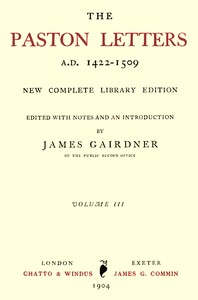
The Paston Letters, A.D. 1422-1509. Volume 3 (of 6) by James Gairdner
Let's be clear: This isn't a novel. There's no single author crafting a neat plot. The Paston Letters are the real, surviving correspondence of a single English family over nearly a century. Edited by James Gairdner, this volume covers a critical period where their fortunes hang by a thread.
The Story
Imagine your family home is a castle. Now imagine a powerful duke—a relative of the king—simply shows up with an army and says it's his. That's the core crisis for the Pastons in these letters. Caister Castle, which they legally own, is besieged by the Duke of Norfolk. The letters fly back and forth: John Paston and his brother are trying to rally support, hire soldiers, and navigate a legal system that often bends to the will of the powerful. Meanwhile, the women of the family, like the formidable Margaret Paston, are holding down other estates, managing tenants, and reporting on local politics with the sharp eye of a wartime general. The 'story' is their daily fight for survival and status, told in real time.
Why You Should Read It
This book completely shatters the glossy, romantic image of the Middle Ages. There are no chivalrous knights here—just lawyers, land disputes, and constant anxiety about money and violence. The magic is in the tiny details. You'll read a letter about a looming siege, followed immediately by one from Margaret asking her husband to buy cloth for a new gown. The humanity is overwhelming. These people feel familiar: they're ambitious, they complain about their in-laws, they fret about their children's marriages, and they are perpetually stressed about property. It makes history feel immediate and tangible. You're not learning about the 15th century; you're eavesdropping on it.
Final Verdict
This is not a casual beach read. It's for the curious reader who wants to get their hands dirty in real history. Perfect for anyone who loved the behind-the-scenes drama of shows like The White Queen or Wolf Hall but wants the authentic, unscripted source material. It's also a goldmine for writers looking to understand the rhythm and concerns of everyday life in the past. Be prepared to read slowly, to flip to the footnotes, and to piece the narrative together yourself. The reward is unparalleled: you'll come away feeling like you know the Pastons personally, and their world will feel less like a distant past and more like a very complicated, high-stakes present.
The copyright for this book has expired, making it public property. Thank you for supporting open literature.
Matthew Williams
1 year agoLooking at the bibliography alone, the inclusion of diverse viewpoints strengthens the overall narrative. Well worth the time invested in reading it.
George Moore
10 months agoIt effectively synthesizes complex ideas into a coherent whole.
Robert Martinez
3 months agoAs someone working in this industry, I found the insights very accurate.
Margaret Smith
8 months agoExceptional clarity on a very complex subject.
William Smith
2 years agoIt’s rare to find such a well-structured narrative nowadays, the author’s unique perspective adds a fresh layer to the discussion. Thanks for making such a high-quality version available.