
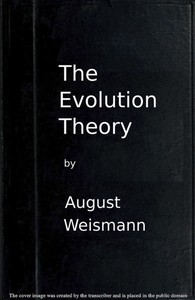
The Evolution Theory, Vol. 1 of 2 by August Weismann
Let's be clear upfront: this isn't a beach read. August Weismann's The Evolution Theory, Vol. 1 is a foundational science text from 1904. But don't let that scare you off. Its core argument is surprisingly straightforward and utterly revolutionary for its time.
The Story
There's no protagonist in the traditional sense. The 'story' is Weismann's relentless campaign against the theory of the inheritance of acquired characteristics. This was the widespread belief that traits an organism developed during its lifetime (like a muscle built from hard work) could be passed directly to its children. Weismann said no. He built what he called the 'germ-plasm' theory. He argued that there is a special, isolated line of cells (the germ plasm) that carries hereditary information from one generation to the next. Your body cells are separate. What happens to your body in your life doesn't rewrite the instructions in the germ plasm. The famous (and kinda grim) mouse-tail experiment is cited as proof: cutting off tails for generations didn't produce tailless mice. The information in the germ plasm remained unchanged.
Why You Should Read It
Reading Weismann is like getting a backstage pass to a major shift in human thought. You feel the frustration of a brilliant mind cutting through the fog of a bad idea. His writing is meticulous, sometimes dry, but his logical dismantling of Lamarckian inheritance is powerful. You see the bedrock of modern genetics being laid. It's humbling to realize how recent and hard-won this knowledge was. This isn't just about biology; it's about how science corrects itself. Weismann wasn't fully right about everything (the intricacies of DNA were unknown), but he was right about the most important principle: inheritance has a protected, digital-like code that life experiences can't easily edit.
Final Verdict
This book is perfect for curious readers who love the history of ideas, or for anyone in biology who wants to understand the roots of their field. It's for the person who enjoys a good intellectual detective story, where the clue is a mouse's tail and the mystery is the secret of life itself. If you prefer fast-paced narratives, this will be a slow, rewarding grind. Think of it less as a book to race through and more as a key historical document to absorb. You're not just reading about theory; you're witnessing the moment biology grew up.
You are viewing a work that belongs to the global public domain. Thank you for supporting open literature.
Michael Taylor
1 year agoI was particularly interested in the case studies mentioned here, the visual layout and supporting data make the reading experience very smooth. This has become my go-to guide for this specific topic.
Emily Thompson
1 month agoClear, concise, and incredibly informative.
Daniel Martinez
1 year agoThis is one of those stories where the flow of the text seems very fluid. I couldn't put it down.
Kimberly Jackson
7 months agoPerfect.


Christopher Williams
2 months agoHaving explored several resources on this, I find that the author’s unique perspective adds a fresh layer to the discussion. It’s a comprehensive resource that doesn't feel bloated.