About 43 minutes
Pictures Don't Lie — Key Ideas to Explore
Other Worlds
9,853 recorded words. 1 minutes difference from this book's estimate.
View Gutenberg source #51193
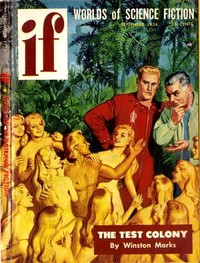
The source record for A Gift For Terra — Story, Setting & Ideas measures this digital text at 9,955 words, 44 min estimated reading time, and 2 detected text sections.
The text analysis averages about 15.2 words per sentence, while the detected sections provide another way to judge how the source is divided.
Project Gutenberg metadata also associates the work with “Science fiction,” connecting these edition facts with the source record’s subject description.
Explore this collection
These alternatives are selected using recorded categories and estimated reading time.
About 43 minutes
Other Worlds
9,853 recorded words. 1 minutes difference from this book's estimate.
View Gutenberg source #51193About 41 minutes
Other Worlds
9,295 recorded words. 3 minutes difference from this book's estimate.
View Gutenberg source #32078About 47 minutes
Other Worlds
10,620 recorded words. 3 minutes difference from this book's estimate.
View Gutenberg source #32820Search stored excerpts and compare books → Choose by your preferences →
Choices use stored catalog measurements. Estimates vary with reading speed. A shared category is a catalog label, not a claim that two books have the same argument or literary quality.
Search reads excerpt text stored with this catalog and links to its associated Gutenberg record. The connection is stored in the site database; this tool does not recheck that every excerpt is word-for-word identical to that external record. Excerpt search does not cover every chapter and does not verify historical publication dates.
Catalog snapshot checked: 2026-09-26. Coverage: 92 public books, 92 available source excerpts.
Calculated from edition completeness, EPUB availability, text structure and catalogue metadata. Not a user rating.
Total of 100 points, scaled to a 2.5-5.0 range. Editions with an empty description or a missing EPUB file are not scored.
Public-domain source text
The source text is kept in the dedicated reader, separate from this catalogue record and its commentary.
From its first sentence, Fox B. Holden's A Gift For Terra establishes a voice that is both immediate and disoriented. The protagonist, Johnny Love, regains consciousness with a pounding head and the blunt recognition that his navigator is dead. The prose mirrors his fractured state: short, declarative clauses pile up without transition, and sensory details—sand sifting like a "cold, red river," the "hollow sound of laughter" inside his helmet—create a claustrophobic intimacy. Holden avoids exposition, letting the reader piece together the crash through Love's staggered perceptions. This technique of limited, unreliable narration persists throughout the excerpts, as Love experiences compulsions, hallucinations, and memory gaps that the text does not fully explain.
Holden's word choices consistently reinforce the protagonist's unstable mental state. Verbs like "wrenched," "heaved," and "buckled" in the opening paragraph emphasize violent, involuntary motion. Later, Love's actions are described as happening to him: "a will that was not his own took hold," and consciousness is "squeezed" from him. The narrative frequently shifts between active and passive constructions, blurring agency. Phrases such as "there was no thought, no understanding" and "none of this was real" directly state the character's confusion, while the repetition of "too"—"too high," "too flat," "too silent"—underscores an oppressive, alien environment that defies human scale.
Dialogue in the excerpts is sparse and often internal. The only direct speech from another being comes in the form of "thought-words" delivered by an unseen Martian: "Man of—Earth! We are friendly." The hyphenated hesitation in "Man of—Earth" suggests a translation process or a being unfamiliar with human speech. Holden uses italics for telepathic communication, distinguishing it from spoken dialogue. Love's own internal monologue is rendered in a colloquial, almost hard-boiled register—"His head hurt like blazes," "fighting like hell"—which contrasts sharply with the alien's formal, stilted phrasing. This linguistic gap reinforces the cultural and cognitive divide between human and Martian.
Three sensory motifs recur across the excerpts: sand, silence, and light. Sand is described as a "cold, red river," a "crimson" reflection, and a "sucking" force that clutches at Love's boots. It is both a physical obstacle and a symbol of the planet's deadness. Silence is emphasized through negatives: "no motion," "too still," and the absence of sound except for wind and his own heartbeat. Light is harsh and unfiltered, hurting his eyes even through a helmet. These motifs create a consistent atmosphere of barren hostility. Notably, the sand's color is specified as red, but Holden avoids exoticizing it; the description remains tactile and oppressive rather than picturesque.
The narrative structure in the excerpts is built around gaps and repetitions. Love's consciousness flickers on and off, marked by phrases like "returning consciousness told him" and "His full consciousness came flooding back." Each return brings new information but also new mysteries. The story jumps from the crash to a dreamlike sequence of running, then to waking under a transparent dome. Time is ambiguous: "How far had he walked; how long?" The reader is left to infer connections between events, such as the relationship between the "dreams" and the later revelation of a stolen device. This fragmentary structure mirrors Love's own incomplete understanding and keeps the reader in a state of uncertainty.
Holden's prose rewards attention to its deliberate roughness. The story does not offer easy explanations for the alien technology or the compulsions Love experiences; instead, it invites the reader to share his confusion. Readers may find it useful to track what Love knows versus what the text implies, and to note where the narrative withholds information. The interplay between Love's colloquial voice and the Martians' formal telepathy also hints at broader themes of communication and trust that the excerpts only begin to explore.
Rereading A Gift For Terra, I kept thinking of that other manuscript sitting on my desk, the one whose opening chapters feel like a slow exhale after Holden’s frantic sandstorms. Both share a quiet hum of something just beyond perception, that unsettling calm before the unseen acts. Odd, how a 1954 Mars landing still echoes in Watch (First 25,000 words) — Text and Context, a familiar shadow I hadn’t expected to find.
Build a private reading journal entry for this title.