About 40 minutes
Shipping Clerk — Reading Notes
Machines Invention
8,976 recorded words. 0 minutes difference from this book's estimate.
View Gutenberg source #50796
For Keep Your Shape — Context and Discussion, the stored edition analysis reports 8,976 words, 40 min estimated reading time, and 2 detected text sections.
The text analysis averages about 12.5 words per sentence, while the detected sections provide another way to judge how the source is divided.
Project Gutenberg metadata also associates the work with “Science fiction,” connecting these edition facts with the source record’s subject description.
Explore this collection
These alternatives are selected using recorded categories and estimated reading time.
About 40 minutes
Machines Invention
8,976 recorded words. 0 minutes difference from this book's estimate.
View Gutenberg source #50796About 41 minutes
Machines Invention
9,276 recorded words. 1 minutes difference from this book's estimate.
View Gutenberg source #32765About 36 minutes
Machines Invention
8,247 recorded words. 4 minutes difference from this book's estimate.
View Gutenberg source #32735Search stored excerpts and compare books → Choose by your preferences →
Choices use stored catalog measurements. Estimates vary with reading speed. A shared category is a catalog label, not a claim that two books have the same argument or literary quality.
Search reads excerpt text stored with this catalog and links to its associated Gutenberg record. The connection is stored in the site database; this tool does not recheck that every excerpt is word-for-word identical to that external record. Excerpt search does not cover every chapter and does not verify historical publication dates.
Catalog snapshot checked: 2026-09-26. Coverage: 92 public books, 92 available source excerpts.
Calculated from edition completeness, EPUB availability, text structure and catalogue metadata. Not a user rating.
Total of 100 points, scaled to a 2.5-5.0 range. Editions with an empty description or a missing EPUB file are not scored.
Public-domain source text
The source text is kept in the dedicated reader, separate from this catalogue record and its commentary.
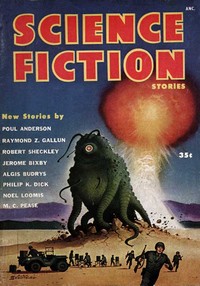
Robert Sheckley's 'Keep Your Shape' opens with the Grom pilot Pid descending toward a green planet, worried about the fate of twenty previous expeditions. The story immediately establishes a distinctive voice through its focus on shape-discipline: Pid scolds his crew for 'promiscuous Shapelessness,' a phrase that blends bureaucratic formality with biological fluidity. The narrative pace mirrors the Grom's own control—tight and purposeful during mission briefings, then loosening as Pid experiments with Earth forms. The excerpts show a careful modulation between the clipped, duty-bound dialogue of the Grom and the chaotic sensory descriptions when Pid adopts a Dog-shape, overwhelmed by 'the near-brilliance' of smells and sounds.
The story's opening establishes a rigid hierarchy among the Grom, conveyed through precise word choices. Pid is a high-caste Pilot, while Ger the Detector and Ilg the Radioman are 'lower castes ... notoriously prone to Shapelessness.' The narration adopts Pid's perspective, using terms like 'Optimum Pilot's Shape' and 'The Shapeless One' as if they were natural categories. This voice creates a sense of internal logic: the Grom's obsession with form is both a cultural value and a plot device. The reader learns about their society through Pid's admonishments, not through exposition. The language remains controlled, mirroring the discipline Pid demands, until the mission forces him to abandon it.
When Pid first attempts a Dog-shape, the narrative pace accelerates dramatically. The text shifts from measured sentences to a barrage of impressions: 'The woods behind him had suddenly become a mad-house.' Sheckley uses short, fragmented clauses to convey Pid's disorientation: 'Utterly confused, he lost control and became Shapeless.' The Dog-shape's 'appalling sharpness of senses' drives him to hide in a bush. Later, the Man-shape proves 'unspeakably clumsy,' with a heavy, plodding rhythm: 'Thud of foot on ground. Drag the other leg forward in a heavy arc. Thud.' These passages contrast sharply with the Grom's fluid movements, emphasizing the difficulty of imitation. The Sparrow-shape introduces a lighter, more playful tone, but even that ends in a stumble.
The story's pacing is tied directly to Pid's shape. In Grom form, the narrative is deliberate, with long paragraphs of internal deliberation. When he shifts to Earth animals, the sentences shorten, mimicking the creature's sensory experience. The Dog-shape brings a 'dizzying sensory assault'; the Man-shape, a 'dull, stiff, half-alive inadequacy.' The Sparrow-shape introduces a flurry of motion: 'diving, hedgehopping, even looping.' Each form has its own tempo, and Pid's struggle to control both shape and pace becomes the story's central tension. The Displacer in his body pouch 'pulsed and tugged,' a physical reminder of the mission's urgency, yet Pid keeps hesitating, unable to find a form that balances speed, unobtrusiveness, and control.
Readers should attend to how Sheckley uses the Grom's shape-discipline as a narrative device: the story's voice and pace are not merely stylistic choices but reflections of Pid's identity crisis. The excerpts suggest a tale less about alien invasion than about the difficulty of maintaining a coherent self under pressure. Pay attention to the moments when the prose becomes fragmented or fluid—they mark the points where Pid loses his grip on who he is supposed to be.
That rainy afternoon, Sheckley’s Grom shedding one skin for another kept circling back to how we all improvise our selves. The discipline of holding a shape felt achingly familiar. Later, idly, I picked up Ask a Foolish Question — Context and Discussion, and it touched the same quiet nerve—about rules we mistake for choices, and the patience of asking why. One book simply led to the other.
Answer a few questions and save a private reflection on this device.