About 27 minutes
The Amateurs — Background and Themes
Machines Invention
6,136 recorded words. 1 minutes difference from this book's estimate.
View Gutenberg source #51081
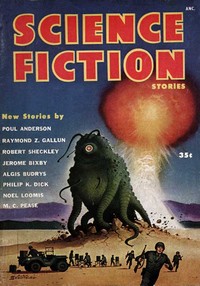
Ask a Foolish Question — Context and Discussion can be approached with a clearer sense of reading commitment from its source measurements: 5,855 words, 26 min estimated reading time, and 1 detected text section.
The text analysis averages about 14.1 words per sentence, while the detected sections provide another way to judge how the source is divided.
Project Gutenberg metadata also associates the work with “Science fiction,” connecting these edition facts with the source record’s subject description.
Explore this collection
These alternatives are selected using recorded categories and estimated reading time.
About 27 minutes
Machines Invention
6,136 recorded words. 1 minutes difference from this book's estimate.
View Gutenberg source #51081About 25 minutes
Machines Invention
5,579 recorded words. 1 minutes difference from this book's estimate.
View Gutenberg source #51234About 24 minutes
Machines Invention
5,449 recorded words. 2 minutes difference from this book's estimate.
View Gutenberg source #32592Search stored excerpts and compare books → Choose by your preferences →
Choices use stored catalog measurements. Estimates vary with reading speed. A shared category is a catalog label, not a claim that two books have the same argument or literary quality.
Search reads excerpt text stored with this catalog and links to its associated Gutenberg record. The connection is stored in the site database; this tool does not recheck that every excerpt is word-for-word identical to that external record. Excerpt search does not cover every chapter and does not verify historical publication dates.
Catalog snapshot checked: 2026-09-26. Coverage: 92 public books, 92 available source excerpts.
Calculated from edition completeness, EPUB availability, text structure and catalogue metadata. Not a user rating.
Total of 100 points, scaled to a 2.5-5.0 range. Editions with an empty description or a missing EPUB file are not scored.
Public-domain source text
The source text is kept in the dedicated reader, separate from this catalogue record and its commentary.
The story opens not with its human characters but with Answerer itself, an entity that "Knew" and was built by a race that also "Knew." This prologue establishes a recursive structure: Answerer is defined by its purpose, yet its builders remain deliberately vague. The narrative then shifts abruptly to two men in a spaceship, Lingman and Morran, whose physical suffering—Lingman's "feeble heart" pounding "angrily against the brittle rib-case"—mirrors the strain of seeking ultimate knowledge. The juxtaposition of cosmic scale and bodily frailty sets up the central tension.
The story's opening paragraphs describe Answerer through a series of negations and qualifications: "large to some and small to others," "complex, although some believed that he was really very simple." This deliberate ambiguity extends to the builders, of whom "the less said the better." The prose circles around definitions without pinning them down, mimicking the entity's own nature. Answerer is eager to answer but can only respond to "a legitimate question." This limitation becomes the story's structural hinge. The text repeatedly uses short, declarative sentences—"He Knew," "He was The Answerer"—that contrast with the later, more frantic dialogue of the human characters. The shift from omniscient narration to limited human perspective mirrors the gap between the answerer and the questioner.
Sheckley grounds the abstract quest in physical detail. Lingman's heart "balked and sulked, pounded angrily against the brittle rib-case," while Morran's "strong body was built for strain and stress." The journey into space is described as "sub-space like an eel into oil," a simile that emphasizes smooth, almost organic movement. The characters' bodies become instruments of measurement: Lingman's failing health sets a deadline, and the zero-gravity relief is described as "vast relief" twice in quick succession. This repetition underscores the cost of the journey. The physical ordeal is not just backdrop but a metaphor for the difficulty of formulating a valid question. The old man's "taloned fingers" and "skull emerging" suggest a body already becoming skeletal, as if the quest is consuming him.
A key passage has Lingman, in a "dim voice," argue that a scientist would know "the limitations of the questioner." Morran retorts with an analogy: explaining relativity to a bushman, or a worm wanting to know "the nature of dirt." This image recurs in the closing paragraphs, where Answerer mumbles "the true questions" that no one can understand. The story thus builds a layered argument: the quality of the answer depends on the quality of the question, and the quality of the question depends on the questioner's prior knowledge. The characters are aware of this paradox—Lingman mutters "We're bushmen"—yet they continue. The narrative does not resolve the paradox but lets it echo in the final line: "In order to ask a question you must already know most of the answer."
The story's structure is circular. It begins and ends with Answerer alone on his planet, waiting. The opening describes him as "as he should be"; the closing repeats that he is "exactly the right size." The middle section, with its human drama, is framed as a failed encounter. The narrative voice in the frame is detached, almost mythic, while the human scenes are tense and immediate. This alternation creates a rhythm of expansion and contraction. The final paragraphs return to the impersonal tone, but now with a note of futility: Answerer "cannot help the people who come to him." The story's brevity—under 6,000 words—forces this structure to work efficiently. The repetition of key phrases ("long enough," "as some judge time") reinforces the sense of a closed loop, where the humans' journey changes nothing for Answerer.
What exactly Lingman and Morran ask Answerer is never shown. The story cuts from their arrival to the aftermath, leaving the crucial moment offstage. This gap is deliberate: the narrative withholds the very thing the characters seek. Instead, the reader is left with the implication that the question was invalid, or that the answer was incomprehensible. The final image of Answerer "mumbling the questions to himself" suggests that the true questions are unaskable. The story thus becomes a meditation on the limits of language and knowledge, using its own ellipsis as proof. The reader, like the characters, must infer what happened from the fragments provided.
Sheckley's story rewards attention to its framing devices and the physical details that anchor its philosophical concerns. The contrast between the cosmic and the bodily, the repeated motifs of size and duration, and the withheld climax all contribute to a tight, ironic fable. Readers may find that the story's argument about questions and answers applies as much to the act of reading as to the characters' quest: the text itself answers only what one is prepared to ask.
That afternoon, the rain against my window blurred the letters of Sheckley’s story, and I kept circling the same ache: how we grope for words before we truly know them. Afterwards, I found myself leafing through A Gleeb for Earth — Reading Notes, its margins full of the same quiet bewilderment, as if the answers were always hiding in our own stumbling questions.
Create a short personal record of your experience with this book.