About 76 minutes
Planet of the Gods — Key Ideas to Explore
Other Worlds
17,468 recorded words. 161 minutes difference from this book's estimate.
View Gutenberg source #32696
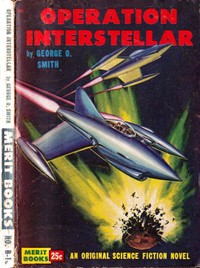
The source record for Operation Interstellar — Themes and Context measures this digital text at 54,383 words, 3 hr 57 min estimated reading time, and 6 detected text sections.
The text analysis averages about 14.0 words per sentence, while the detected sections provide another way to judge how the source is divided.
Project Gutenberg metadata also associates the work with “Science fiction,” connecting these edition facts with the source record’s subject description.
Explore this collection
These alternatives are selected using recorded categories and estimated reading time.
About 76 minutes
Other Worlds
17,468 recorded words. 161 minutes difference from this book's estimate.
View Gutenberg source #32696About 61 minutes
Other Worlds
13,804 recorded words. 176 minutes difference from this book's estimate.
View Gutenberg source #40992About 61 minutes
Other Worlds
13,855 recorded words. 176 minutes difference from this book's estimate.
View Gutenberg source #51170Search stored excerpts and compare books → Choose by your preferences →
Choices use stored catalog measurements. Estimates vary with reading speed. A shared category is a catalog label, not a claim that two books have the same argument or literary quality.
Search reads excerpt text stored with this catalog and links to its associated Gutenberg record. The connection is stored in the site database; this tool does not recheck that every excerpt is word-for-word identical to that external record. Excerpt search does not cover every chapter and does not verify historical publication dates.
Catalog snapshot checked: 2026-09-26. Coverage: 92 public books, 92 available source excerpts.
Calculated from edition completeness, EPUB availability, text structure and catalogue metadata. Not a user rating.
Total of 100 points, scaled to a 2.5-5.0 range. Editions with an empty description or a missing EPUB file are not scored.
Public-domain source text
The source text is kept in the dedicated reader, separate from this catalogue record and its commentary.
The opening pages of Operation Interstellar establish a deliberate, sensory-rich pace. Paul Grayson walks toward the spaceport, savoring spring air and city sounds before his confinement in a cramped spacecraft. The prose lingers on the contrast between open freedom and the coming isolation: 'canned air, pungent with the odor of compressor oil and the tang of the greenery used to replenish the oxygen.' This unhurried start, rich in physical detail, sets a reflective tone that will later fracture into paranoia and action.
Smith’s narrative voice shifts markedly as the story progresses. Early passages are meditative, with Grayson musing on his destination—a 'stinking little overheated mote' around Proxima Centauri. But once the plot accelerates, the prose becomes terse and driven by dialogue and sudden revelations. The reader is moved from a contemplative astronaut to a man caught in a web of impersonation and conspiracy, with the language tightening to match his rising tension.
The novel’s first chapter is a study in contrast. Grayson’s walk is described with almost leisurely specificity: he listens to 'the myriad of sounds made by his fellow men' and looks toward Alpha Centauri. The prose is expansive, mirroring his sense of freedom. But this openness is immediately undercut by the claustrophobic reality of space travel. Smith uses the physical details of the spacecraft—'functional scientific equipment,' 'medically acceptable but aesthetically horrible' air—to create a sense of impending restriction. The narrative voice here is that of an engineer who observes his environment with clinical precision, yet the emotional weight of leaving Earth is palpable.
As the story moves into the space station and later into the conspiracy, the pace accelerates. Sentences grow shorter, and the focus shifts from internal reflection to external action. The early, almost poetic descriptions of space give way to terse exchanges and rapid plot developments. This shift in pace is not abrupt but gradual, reflecting Grayson’s own transition from a man with time to think to one forced to react.
Paul Grayson’s narrative voice is marked by a persistent idealism that clashes with the events around him. He believes in the power of innocence and self-confidence: 'the right way to handle false charges was and is to face them firmly.' Smith renders Grayson’s internal monologue with a mix of self-awareness and naivety. The character acknowledges that others might see his situation differently—he recalls cases where 'the murderer was found with the smoking gun in his pocket'—yet he insists his own case is different.
This voice becomes a lens for the novel’s themes of trust and perception. Grayson’s reflections on running away versus facing accusations reveal a man who wants to believe in justice even as evidence mounts against him. The prose captures his bewilderment: he cannot understand why anyone would oppose a 'common blessing' like interstellar communication. Smith uses this idealism to heighten the tension, as the reader watches Grayson’s certainties erode with each new impersonation and betrayal.
As the plot thickens, the narrative pace becomes erratic, mirroring Grayson’s growing paranoia. The early, measured descriptions give way to fragmented thoughts and sudden revelations. The text jumps from Grayson’s internal debate about running to a car ride that ends at an unexpected address—'7111 Bridge Street!' The prose here is clipped, with short paragraphs and exclamation points conveying shock.
Smith also introduces a new character, Hoagland, whose description subverts expectations. Grayson had been told Hoagland was a 'doddering old fogy,' but the man he meets is sharp-eyed and virile, with a voice that 'crackled with virility.' This reversal is typical of the novel’s middle sections, where assumptions are constantly overturned. The pace quickens as Grayson is forced to reassess everyone around him, and the language becomes more urgent, with longer sentences giving way to staccato observations. The reader, like Grayson, is left uncertain who to trust.
Operation Interstellar rewards attention to its shifts in tempo and voice. Smith moves from expansive, sensory description to tight, paranoid prose as Grayson’s situation deteriorates. Readers may find the early chapters deliberately slow, but this pacing establishes the normalcy that makes the later conspiracy unsettling. The novel’s strength lies in its ability to convey a protagonist’s inner conflict through changes in narrative rhythm, rather than through explicit commentary. Approach the text as a study in how a character’s voice adapts to pressure, and the story’s technical details become part of a larger psychological portrait.
I remember how Grayson in Operation Interstellar carried his doubt like a quiet weight, insisting on proof even when all light seemed borrowed. That same patient honesty lives in Feet of Clay — Context and Discussion, where faith crumbles into something more tender—not defeat, but a gentler knowing. Some stories share a heartbeat, and these two have always felt like old friends to me.
Build a private reading journal entry for this title.