About 54 minutes
The Hell Ship — Story, Setting & Ideas
Space Future
12,344 recorded words. 3 minutes difference from this book's estimate.
View Gutenberg source #32615
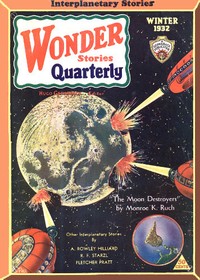
For The Moon Destroyers — Story, Setting & Ideas, the stored edition analysis reports 13,084 words, 57 min estimated reading time, and 2 detected text sections.
The text analysis averages about 19.1 words per sentence, while the detected sections provide another way to judge how the source is divided.
Project Gutenberg metadata also associates the work with “Science fiction,” connecting these edition facts with the source record’s subject description.
Explore this collection
These alternatives are selected using recorded categories and estimated reading time.
About 54 minutes
Space Future
12,344 recorded words. 3 minutes difference from this book's estimate.
View Gutenberg source #32615About 53 minutes
Space Future
12,057 recorded words. 4 minutes difference from this book's estimate.
View Gutenberg source #32657About 46 minutes
Space Future
10,438 recorded words. 11 minutes difference from this book's estimate.
View Gutenberg source #51268Search stored excerpts and compare books → Choose by your preferences →
Choices use stored catalog measurements. Estimates vary with reading speed. A shared category is a catalog label, not a claim that two books have the same argument or literary quality.
Search reads excerpt text stored with this catalog and links to its associated Gutenberg record. The connection is stored in the site database; this tool does not recheck that every excerpt is word-for-word identical to that external record. Excerpt search does not cover every chapter and does not verify historical publication dates.
Catalog snapshot checked: 2026-09-26. Coverage: 92 public books, 92 available source excerpts.
Calculated from edition completeness, EPUB availability, text structure and catalogue metadata. Not a user rating.
Total of 100 points, scaled to a 2.5-5.0 range. Editions with an empty description or a missing EPUB file are not scored.
Public-domain source text
The source text is kept in the dedicated reader, separate from this catalogue record and its commentary.
The story opens not in space but in a Himalayan seismological laboratory, where Professor Erickson and his assistant Jack Holden watch a stylus run off the graph—a concrete, technical detail that grounds the fantastic premise in a specific scientific practice. The earthquake that destroys New York is attributed to the Laurentian fault, a real geological feature, lending a veneer of plausibility to the catastrophe. This blend of period science (the moon's gravitational effects on Earth) and pulp adventure is characteristic of the tale.
The excerpts show a narrative that moves quickly from disaster to interplanetary action: within a few pages, Holden is on the moon, exploring a cliff base littered with wrecked ships. The prose is efficient, favoring action over description, and the dialogue often serves to convey plot information rather than character depth.
The catalog subject "Science fiction" is accurate, but the excerpts reveal a particular use of science: it functions primarily as a trigger for the plot rather than a sustained focus. The opening pages devote considerable space to explaining the moon's gravitational influence on Earth, complete with references to tides and earthquakes. This expository passage, presented as a preamble, establishes a pseudo-scientific rationale for the lunar threat. However, once the action shifts to space, the science recedes. The space suits, ships, and ray pistols are described in functional terms, without detailed technical explanation. The story is more concerned with the adventure—Holden's exploration of the pirate cave, his reunion with Jean—than with the mechanics of space travel. The science serves as a credible springboard into a world of space pirates and rescued sweethearts, a common pattern in early pulp science fiction.
The catalog includes "Space pirates" as a subject, and the excerpts confirm this: the moon is home to a band of pirates who attack interplanetary ships, using a sharp-pointed prow to breach hulls. The description of wrecked ships "piled up at the base of the precipice" evokes a grim junkyard, and the pirates' hideout is a cave walled with metal plates from captured vessels. This setting is vividly rendered in a few strokes: the "loosely piled dust" on the moon's surface, the sudden darkness when the cliff's shadow falls, the "silvery gleam" of a wrecked ship. The pirates themselves remain shadowy—their motives and organization are not detailed in the excerpts—but their presence drives the plot. The lunar environment is not explored for its own sake but serves as a backdrop for a rescue mission. The story's moon is a lawless frontier, a place where Earth's rules do not apply, which aligns with the maritime fiction tradition of pirates and hidden coves, transposed to space.
The excerpts show a reliance on stock heroic conventions: the resourceful protagonist (Holden), the damsel in distress (Jean), and the climactic reunion. Holden is described as "slender yet strong," with "steel gray eyes" and a "tanned" complexion—a standard pulp hero. His actions are decisive: he refuses a companion for his solo exploration, uses a compass to navigate, and enters the air-lock without hesitation. The emotional peak is the reunion with Jean, rendered in a brief but intense passage: "With a single movement he flung off his helmet and seized her in his arms." The narrative does not dwell on their feelings; instead, Jean immediately provides exposition about the pirates' stronghold. This prioritization of plot over emotion is typical of the adventure genre. The story also includes a moment of personal stakes: the wrecked ship Gloriana is identified as the transport Jean boarded a year earlier, adding a layer of loss and hope to Holden's mission.
The excerpts offer a self-contained episode—the discovery of the pirate lair and the reunion—but leave the larger conflict unresolved. Readers should expect a fast-paced narrative that values incident over introspection. The story's brevity (under 14,000 words) means it moves quickly from one set piece to the next. Pay attention to how the author uses specific details, like the compass pointing toward the San Francisco, to anchor the action in a recognizable world. The blend of disaster, space travel, and pirate adventure makes this a representative sample of early 1930s pulp science fiction.
I keep thinking about that old serial where the moon hides pirates, and how the quiet dread of vast empty space felt almost cozy next to the danger. The Holes Around Mars — Edition Insights brought that same lingering ache back—not the action, but the strange loneliness between worlds, like remembering a place you’ve only seen in a half-forgotten dream.
Your answers remain private and are stored only in this browser.