About 27 minutes
Probability — A Closer Reading
Space Future
6,206 recorded words. 2 minutes difference from this book's estimate.
View Gutenberg source #32739
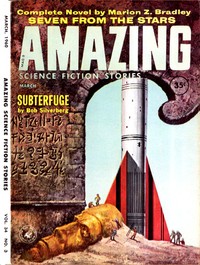
This digital edition of Suzy — A Reader’s Guide is described by source-level measurements including 5,568 words, 25 min estimated reading time, and 1 detected text section.
The text analysis averages about 17.2 words per sentence, while the detected sections provide another way to judge how the source is divided.
Project Gutenberg metadata also associates the work with “Science fiction,” connecting these edition facts with the source record’s subject description.
Explore this collection
These alternatives are selected using recorded categories and estimated reading time.
About 27 minutes
Space Future
6,206 recorded words. 2 minutes difference from this book's estimate.
View Gutenberg source #32739About 22 minutes
Space Future
4,866 recorded words. 3 minutes difference from this book's estimate.
View Gutenberg source #51009About 29 minutes
Space Future
6,462 recorded words. 4 minutes difference from this book's estimate.
View Gutenberg source #32688Search stored excerpts and compare books → Choose by your preferences →
Choices use stored catalog measurements. Estimates vary with reading speed. A shared category is a catalog label, not a claim that two books have the same argument or literary quality.
Search reads excerpt text stored with this catalog and links to its associated Gutenberg record. The connection is stored in the site database; this tool does not recheck that every excerpt is word-for-word identical to that external record. Excerpt search does not cover every chapter and does not verify historical publication dates.
Catalog snapshot checked: 2026-09-26. Coverage: 92 public books, 92 available source excerpts.
Calculated from edition completeness, EPUB availability, text structure and catalogue metadata. Not a user rating.
Total of 100 points, scaled to a 2.5-5.0 range. Editions with an empty description or a missing EPUB file are not scored.
Public-domain source text
The source text is kept in the dedicated reader, separate from this catalogue record and its commentary.
Watson Parker's Suzy (1960) opens with astronaut Whit Clayborne in an observation capsule, 143 days into a 550-day mission. His only contact with Earth is Suzy, a WAC operator at Point Magu. The story immediately establishes a paradox: Suzy's voice is described as "his only link with sanity," yet the relationship is governed by a corporate promise that forbids her from saying she loves him back. This tension between genuine human connection and institutional control drives the narrative.
The story's setting is claustrophobic and sensory-deprived: "The cold. The darkness. The quiet. And the solitude." Whit's environment is reduced to a bulkhead clock that "clicked impersonally," sweat on his forehead, and his own moans. Parker uses repetitive, fragmented sentences to mirror Whit's psychological strain. The capsule is not just a spacecraft but a test chamber for human endurance, where the "economical human machine" replaces fifty tons of electronics. The mission's success depends on Whit's mental stability, which is deliberately engineered through Suzy's voice.
Suzy exists only as a voice—never described physically. Her function is to maintain Whit's morale, but she operates under a strict promise: "not to say she loved you back." This creates a one-way emotional dependency. Whit repeatedly proposes marriage; Suzy deflects with the same line: "You can't handle the merchandise." The story reveals that Suzy is part of a system designed to keep astronauts "stringing along" until they return safely, then discard them. Parker thus critiques the commodification of intimacy in institutional settings, where affection is a tool for productivity.
Whit's daily report is a "ritual" to keep him thinking: "Nothing to report, sir, all equipment functioning." The repetition of "Suzy, Suzy, Suzy!" and the countdown of days ("One hundred and forty-three days out, four hundred and seven to go") structure the narrative. These patterns highlight how routine and obsessive focus on Suzy stave off madness. Yet the story also suggests that this very repetition is a form of control imposed by the mission planners. Whit's love is both genuine and manufactured, a necessary illusion for survival.
Though Earth is never described, it is a constant presence through Suzy's transmissions. The story implies that the return will be painful: Suzy will "turn us loose with our love for you burning a hole in our hearts." Whit's fear is not of space but of the moment he must face Suzy in person, when the promise will force her to withdraw. The narrative thus pivots on an anticipated betrayal, making the reader question whether the mission's psychological support is humane or cruel.
Suzy is a compact study of engineered intimacy and institutional control. Readers should pay attention to the asymmetry between Whit's emotional openness and Suzy's constrained responses. The story's power lies in what is unsaid: the off-stage promise, the unseen Earth, and the inevitable aftermath. Parker's spare prose and repetitive structure reinforce the theme of isolation, making this a pointed commentary on the human cost of space exploration.
The rain kept its own time against the window while I reread the passage where Whit hears Suzy’s voice crack. That engineered distance—so precise, yet so porous—lingered with me into the evening. Later, I found myself drifting through The Merchants of Venus — Edition Insights, which carries that same quiet ache of longing packaged as function. One book simply handed me to the other.
A brief reflection can help important ideas stay with you longer.